 Tiếng Việt
 English

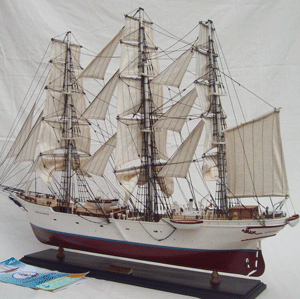
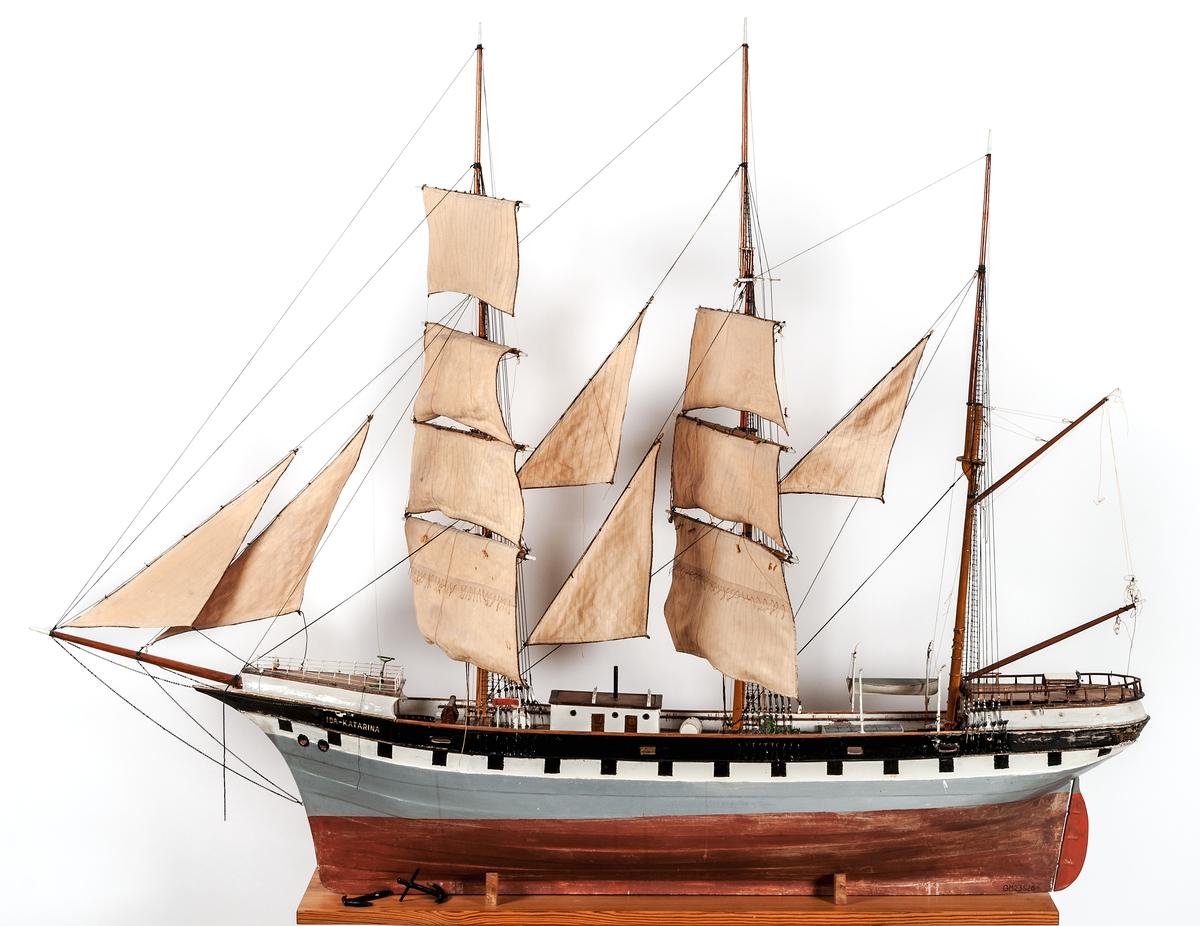
A handcrafted wooden ship model can stay beautiful for decades – it can even become a family heirloom – if it is looked after properly. On the other hand, a couple of humid rainy seasons or a few months in the sun next to a window are enough to warp the wood, fade the paint and leave the rigging sagging. This guide explains in detail how to care for a wooden model ship: where to place it, how to control humidity in damp and tropical climates, how to dust it, how to look after the rigging and sails, how to move it safely, how to prevent mold and wood-boring insects, and how to deal with minor damage at home.
Why wooden ship models need proper care
Wood is a "living" material: it absorbs moisture when the air is damp and releases it when the air is dry. Each time this happens, the fibers swell or shrink slightly. On large pieces of furniture such as tables and cabinets, these movements are hard to notice. But on a model ship made of hundreds of slender parts – masts, yards, railings, hull planks – even a little shrinkage can pop a glue joint, crack the paint or make the rigging alternate between taut and slack.
A model ship also contains materials other than wood: sailcloth, cord, decorative metal fittings and protective paint. Each of them reacts differently to sunlight, dust and humidity. Good care is therefore not a single action but a combination of a sensible location, a stable environment and gentle, regular cleaning habits. You can find the basic instructions for every product on our product care guide page; this article goes into much more detail for each specific situation.
Choose the right display spot: the most important step
Most damage to model ships comes from placing them in the wrong spot. A good location has to meet three conditions at the same time: dry and well ventilated, out of direct sunlight, and protected from knocks.
Good places for a model ship
- A shelf, cabinet or table against an interior wall, well away from windows and doors.
- A living room or study with good air circulation and a fairly stable temperature.
- A solid surface that does not wobble and is wide enough for the whole hull and all the masts to sit inside its edges.
Places to avoid
- Right next to a sunny window, on a balcony or on a covered porch.
- Near an air-conditioning vent, a space heater, a fireplace or the kitchen stove, or above a TV or any other appliance that gives off heat.
- Bathrooms and spots near aquariums or indoor plants – anywhere with regular moisture in the air.
- Narrow passageways, or anywhere small children and pets can reach.
Control humidity: wood's number one enemy
Wooden objects are generally most stable when the relative humidity of the air is between 40 and 60%. Just as important as the absolute number is stability: wood can cope with air that is a little too damp or a little too dry, but it is easily damaged when humidity swings sharply and repeatedly – for example, a closed room with the air conditioning running all day, then windows thrown open to humid evening air.
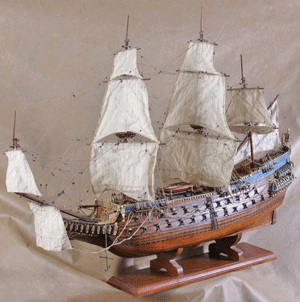
Maritime museums around the world treat climate control in their galleries as the foundation of conservation. The best-known example is the Swedish warship Vasa: the ship sank on her maiden voyage in 1628, was raised in 1961, and now rests in her own museum in Stockholm, where temperature and humidity are regulated continuously so that the original timber does not deteriorate.

At home, you do not need a museum-grade system. A small digital hygrometer placed near the model is enough to tell you when to act. Here is a quick reference table:
| Indoor humidity | Effect on a wooden model | What to do |
|---|---|---|
| Below 35% | Wood shrinks and may develop hairline cracks; glue joints can come loose | Keep air-conditioning or heating airflow away from the model; place a small bowl of water or a humidifier in the room |
| Around 40–60% | The ideal range; the wood stays stable | Keep doing what you are doing and dust regularly |
| 65–80% | Wood absorbs moisture, the rigging may sag, and the risk of mold begins | Close windows on muggy days and use the dry mode on your air conditioner or a dehumidifier |
| Above 80% for long periods | Risk of white or black mold on the wood and sails; metal fittings tarnish | Run a dehumidifier, put desiccant packs inside the display case and inspect the model every week |
Caring for model ships in humid and tropical climates
Humid climates pose their own challenges. In Vietnam, for example, the north has spells of muggy weather in late winter and early spring when walls literally "sweat", while the south and the Central Highlands have rainy seasons lasting several months with almost constant high humidity. Similar conditions are found in many coastal and tropical regions, and in any home during long wet spells. A few simple habits will help your model come through these periods unharmed:
- Keep windows closed when the air is muggy: it sounds counterintuitive, but opening up on humid days only lets more moisture into the house. Close the windows and use the dry (dehumidify) mode of your air conditioner.
- Use a dehumidifier in the display room: if you own several models or valuable wooden pieces, a household dehumidifier is a worthwhile investment.
- Put silica gel packs inside the display case: the color-changing kind tells you when they need to be replaced or dried out. Place them in a corner of the case, not touching the model.
- Check regularly during the wet season: once a week, look closely at the hidden areas under the hull and the undersides of the sails, which is where mold usually appears first.
- Never wipe with a damp cloth: in humid weather it is all the more important not to add water to the wood's surface.
Avoid direct sunlight and heat sources
The ultraviolet light in sunshine fades paint, yellows cloth sails and dries out the surface of the wood. What makes it tricky is that the process is slow: you will not see a difference after a few days, but after a year or two the side of the model facing the window can be noticeably paler than the other side. If the model has to stand in a bright room, use sheer curtains or a UV-filtering window film, or turn the model from time to time so that any fading stays even.
Heat sources are just as harmful: the warmth from incandescent spotlights placed close by, a stove, a fireplace or the back of an electrical appliance dries the wood quickly, cracks the paint and softens the glue. If you want accent lighting in a display cabinet, choose LED lights, which give off very little heat.
How to dust the hull, rigging and sails properly
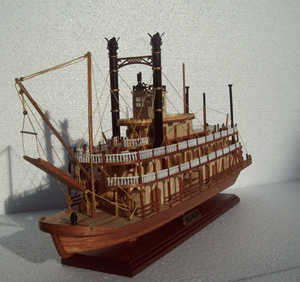
Dust that builds up over time not only dulls a model's colors but also holds moisture on its surface, which encourages mold. At the same time, cleaning the wrong way is one of the most common reasons for snapped rigging lines and knocked masts. Follow these principles:
Tools to use
- A soft brush (a clean makeup brush or a wide artist's brush): dust gently in the direction of the wood grain.
- A blower bulb (the kind used to clean camera lenses): blow dust out of narrow gaps, around knots and off the sails.
- A handheld vacuum on its lowest setting, with the nozzle held well away from the details and a piece of thin cloth over the opening so that small parts cannot be sucked in.
- A dry microfiber cloth for large, flat areas of the hull.
What not to do
- Do not use damp cloths, glass cleaner or cleaning chemicals.
- Do not use coarse feather dusters – the fibers easily catch on the rigging.
- Do not use a hair dryer to blow off dust, because the heat can soften the glue.
- Do not pull or stroke the rigging lines to "straighten" them when they sag a little.
A sensible routine is a light dusting every one to two weeks for a model kept in the open, and every few months for a model inside a display case. For cloth sails, use only a blower bulb or a very soft brush; if a sail has a stain that will not come off, ask the workshop for advice before trying to clean it yourself.
Should you use a display case?
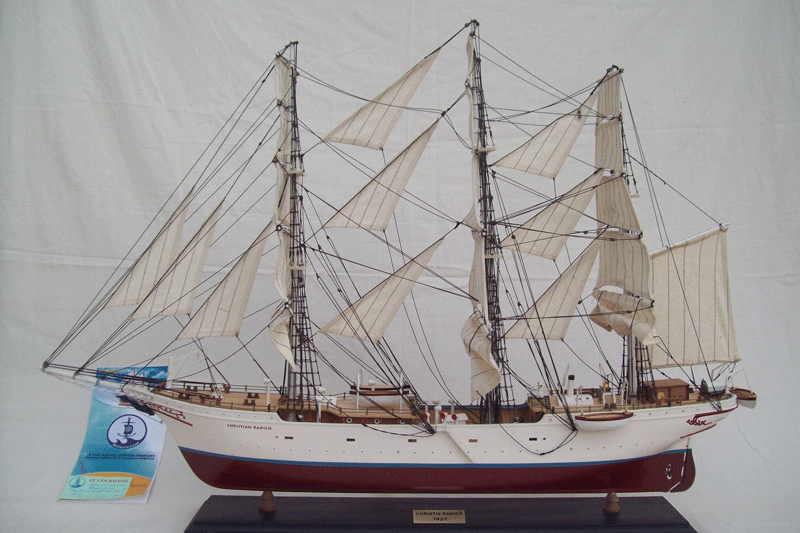
A glass or acrylic display case is the most complete protection for a model ship: it keeps out dust, prevents knocks, softens the effect of sudden humidity changes and keeps curious children and pets away. For models with complex rigging such as the BATAVIA model or the CHRISTIAN RADICH, a case is almost essential if you want to keep the model for many years with very little cleaning.
When you choose a display case, look for:
- Inside dimensions a few centimeters larger than the model in every direction, so that the masts do not touch the top.
- Seals or tight-fitting joints that keep dust out – although you should still open the case to air it a few times a month on dry days.
- UV-filtering glass or acrylic, which is a plus if the case stands in a bright room.
- A solid base with room in a corner for desiccant packs that will not be too visible.

How to handle and move your model safely
A great deal of damage happens in the few seconds it takes to lift a model to clean a shelf or to move house. The golden rule: always lift the model by its stand or by the solid part of the hull, with both hands, and never by the masts, sails, rigging or any protruding detail.
When you need to transport the model over a longer distance – moving home or taking it to an exhibition, for example:
- If you still have the original box and packing materials, reuse them, because they were made to fit the model.
- Wrap the masts loosely in soft acid-free tissue or thin cloth; never put tape directly on the model's parts.
- Secure the stand to the bottom of the box so the hull cannot slide, and fill all empty space with soft packing material.
- Label the box clearly "Fragile – This Way Up" and always keep it upright and level.
- For large models such as the 150 cm HA LONG Sailing Boat, ask the workshop for advice on suitable packing before moving it.
Prevent wood-boring insects and mold
Woodworm, termites and mold tend to appear where the air is damp and nobody looks very often. Make a habit of inspecting your model regularly, especially the underside of the hull and the base where it touches the shelf. Signs to watch for:
- Fine wood dust collecting in little piles under the model or on the shelf: a possible sign of wood-boring beetles.
- Tiny holes in the wood surface that were not there before.
- White, green or black spots on the wood, rigging or sails, or a musty smell when you get close.
- Mud tubes on the wall or the cabinet legs near the model: a sign of active termites in the house.
If you see light mold on the wood surface, move the model to a dry, airy place, brush it clean with a soft brush and let it dry naturally, then deal with the source of moisture in the room. If you see signs of insects, keep the model away from other wooden items and contact the workshop or a professional pest-control service; do not spray insecticide on the model yourself, because the chemicals can damage the paint and the sailcloth. The same advice applies to larger wooden pieces in your home, such as a wooden cabinet or tables and chairs – you can read more in our handcrafted wooden furniture guide.
Fixing minor damage at home
However careful you are, small mishaps can still happen. Here is how to handle the most common ones safely:
| Problem | Can you fix it yourself? | Recommended action |
|---|---|---|
| Rigging sags slightly in humid weather | Usually no need | The lines normally tighten again when humidity drops; do not pull or re-tie them in a hurry |
| A small part (railing, ratline) has come loose | Yes, if you still have the part | Use a tiny amount of wood glue and hold the part in place until it dries; keep any loose part in a small bag if you cannot fix it right away |
| A light scratch in the paint | With caution | Ask the workshop for the paint color before touching it up, to avoid a mismatch |
| A broken mast or rigging snapped in several places | Not recommended | Contact the workshop for advice on repairs |
| A cracked hull or large joints coming apart | Not recommended | Move the model to a dry place and contact the workshop |
The general rule: if you are not sure, do not try to fix it. One wrong repair can turn minor damage into major damage, whereas an experienced craftsman can usually put things right much more quickly.
A suggested care schedule
- Every week: take a quick look at the model and check the hygrometer, especially during rainy seasons and muggy weather.
- Every one to two weeks: dust lightly if the model is kept in the open.
- Every month: check the desiccant packs in the display case and inspect the underside of the hull and the hidden corners.
- Every few months: air the display case on a dry day, clean the model inside it, and turn the model if it stands in a bright room.
- Every year: give the rigging tension, joints and paintwork an overall check, and contact the workshop if you find a problem.
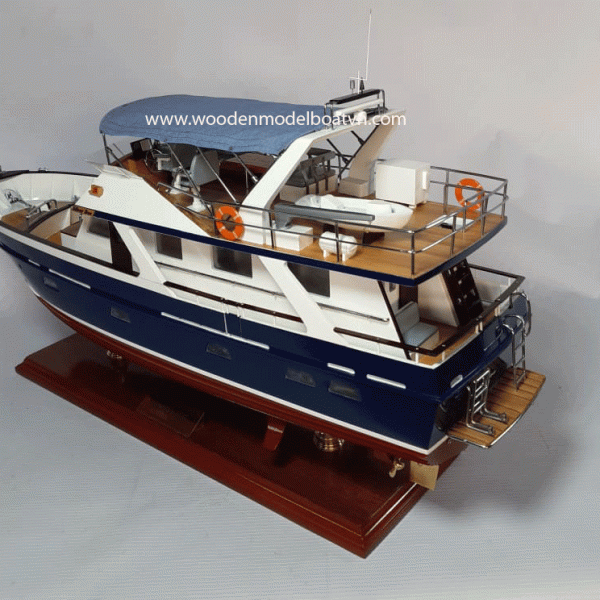
If you are about to buy a new model, read our article on buying a wooden model ship to choose the right model and display spot from the start, or explore our sailing boat collection and modern yachts such as the SILVER DEE model.
Frequently asked questions
What humidity level is best for a wooden model ship?
Wooden objects are generally most stable at a relative humidity of about 40–60%. Even more important is keeping humidity steady and avoiding sudden swings between a cool, dry air-conditioned room and humid outdoor air.
Can I wipe my wooden ship model with a damp cloth?
No. Water makes the wood absorb moisture and can loosen the glue and stain the sails. Use a soft brush, a blower bulb or a dry microfiber cloth instead.
What should I do if the rigging is sagging?
Rigging can sag slightly in damp weather and tighten again when the air is drier. Lower the humidity in the room and watch it for a few days. Do not pull or re-tie the lines yourself; if the problem persists, contact the workshop for guidance.
Can a model ship get moldy in humid weather, and how do I prevent it?
Yes, if high humidity lasts for a long time. Keep windows closed on muggy days, use your air conditioner's dry mode or a dehumidifier, put silica gel packs inside the display case and check the model every week.
Can a broken mast be repaired?
In most cases yes, but the repair is best left to an experienced craftsman. Keep the broken pieces, take photos of the damage and contact the workshop for advice.
Need help caring for or repairing your model?
If your model is showing signs of wear, you would like advice on how to display it, or you need help with a specific problem, contact Vietnam Wooden Ships on +84 908 062 685, send us a message through our contact page, or visit the workshop at 199 Hamlet 1B, Phuoc Thai, Long Thanh, Dong Nai, Vietnam. And bookmark our product care guide for quick reference whenever you need it.