 Tiếng Việt
 English

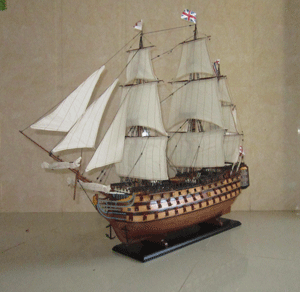
A well-made wooden ship model can stay with its owner for decades. It becomes the centerpiece of a living room or study, a talking point in an office lobby, or a gift that carries real meaning. Yet with so many designs, sizes and price points available, first-time buyers often have no idea what separates a carefully crafted model from one that was rushed. This guide brings together the 10 most important things to know before you buy a wooden model ship: how to read the hull, the rigging and the paint finish, how to choose the right size for your space, what to think about when buying a gift, and which questions to ask before you place an order.
Why it pays to know what you are buying
A model ship is a handmade object, which means its quality depends almost entirely on the skill of the craftsman and the hours spent on each detail. Two models with the same name and the same dimensions can be worlds apart in the symmetry of the hull, the tension of the rigging or the smoothness of the paint. Online photos are usually taken from the most flattering angle, so if you do not know where to look, it is easy to fall for the overall impression and miss the details that decide how good the model will look in ten years' time.
Model ships are also fairly large objects with many fine, fragile parts that can be damaged in transit. A good purchase is therefore not only about picking the right ship. It is also about choosing the right size for the spot where it will be displayed, understanding how the ordering process works, and knowing in advance what to ask the seller. The ten points below follow the order in which most buyers should think them through.
1. Decide what the model is for: display, collecting or a gift
Before you start browsing, answer one simple question: what is this model for? Your answer will shape almost every decision that follows.
- Decoration and display: focus on a graceful silhouette, colors that work with your interior, and a size that fits your shelf or cabinet. Sailing ships with several tiers of sails usually make the strongest visual statement in a room.
- Collecting: look for faithfulness to the original vessel, the number and accuracy of the details, and the history behind the ship. Replicas of famous vessels, such as the VICTORY model or the WASA model, are always popular with collectors.
- Gifts: think about the symbolism (smooth sailing, setting out for new horizons), how easy the model is to carry or transport, and your budget.
If you are not yet sure which style appeals to you, browse the full model ship catalog to see the differences between classic sailing ships, cruise ships, modern yachts and cargo vessels side by side.
2. Study the hull lines and symmetry
The hull is the skeleton of every ship model. A good hull flows in a smooth curve from bow to stern, its two sides are mirror images of each other, and it shows no twist when viewed from above. Whether you are looking at photos or at the model itself, pay attention to the following:
- Look straight at the bow: are both sides of the hull even, and do the masts stand vertical and sit exactly on the centerline?
- Look along the side of the ship: does the sheer line (the upper edge of the hull) curve evenly, without kinks or flat spots?
- Are the proportions of length, beam and height believable, or does the hull look unusually bulky or pinched compared with photos of the real ship?
Hull planking
On well-made handcrafted models, the hull is usually built up from many thin planks running along its length, imitating the way real wooden ships were built. The seams should be tight and even, with no large gaps and no traces of excess glue. If the hull is painted, the surface should be smooth and flat, with no ripples and no paint pooling in the corners. Planking is one of the clearest indicators of how much time the builder was willing to invest, because it cannot be hurried without the result showing.
3. Inspect the rigging and the masts
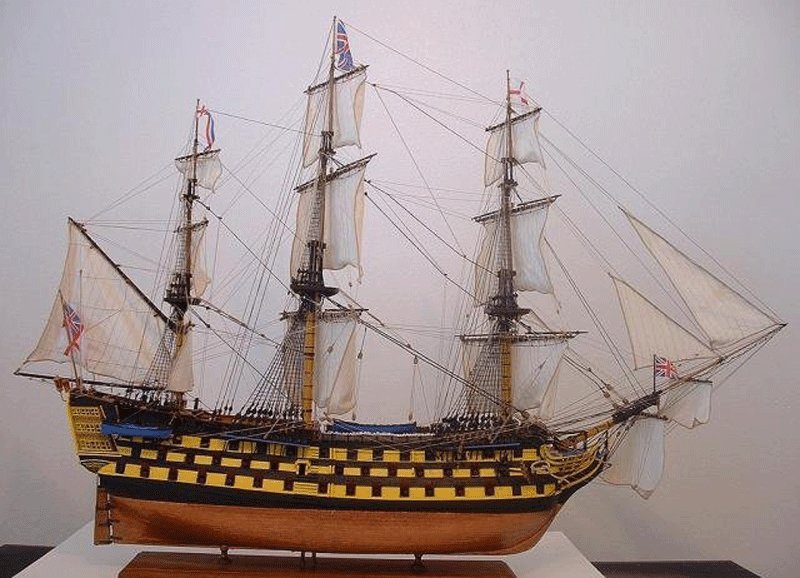
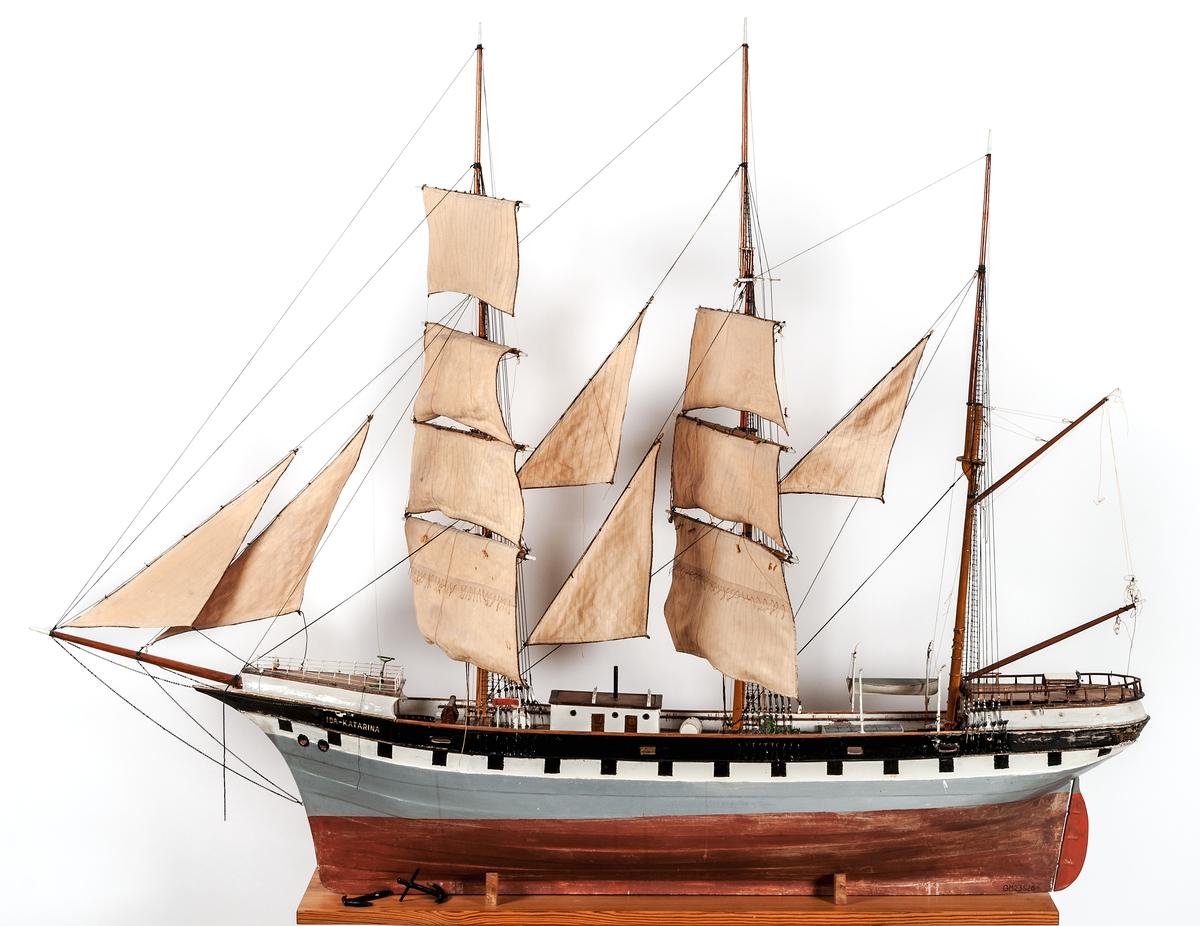
On a sailing ship, the rigging is where craftsmanship shows most clearly. On a real ship, the lines fall into two groups: the standing rigging, which holds the masts in place, and the running rigging, which is used to raise, lower and trim the sails. The more painstaking the model, the more layers of rigging it reproduces, each with the right amount of tension.

When you assess this part of a model, look closely at:
- Line tension: standing rigging should run straight and reasonably taut, without sagging. Lines that are pulled too tight can slowly bend the masts over the years.
- Knots and fixing points: knots should be small and neat, with no loose ends sticking out.
- Masts: straight, sturdy and firmly fixed to the hull; the yards that carry the sails should be parallel and balanced on both sides.
- Ratlines: where the rope ladders are modeled, the rungs should be evenly spaced – a sure sign of patience at the workbench.
4. Evaluate the sails and the paint finish
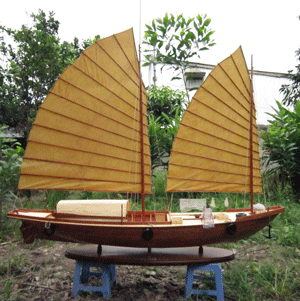
The sails give a model its character. Cloth sails should have neatly hemmed edges and either a flat surface or a gentle, natural billow, as if filled by the wind. Their color should suit the style of the ship: ivory for European sailing ships, reddish brown for traditional Vietnamese junks. Avoid models with wrinkled sails, frayed fabric or sails glued off-center on their yards.
As for the paint, a fine model usually has crisp boundaries between color areas (for example between the underwater hull and the topsides), even decorative stripes, and a thin protective coat that does not look like shiny plastic. On models left in natural wood or finished with oil, the grain should be clearly visible and the color even, without blotches.
5. Choose the right size for your space
This is the most common mistake of all: buying a model that is too large for its shelf, or so small that it gets lost in a spacious living room. Before you order, measure the length, depth and above all the height of the space where the model will stand. Sailing ships are often almost as tall as they are long because of their masts, while cruise ships and cargo ships tend to be long and low.
| Display space | Suggested length | Example models |
|---|---|---|
| Desk or bookshelf | About 50–60 cm | LA JACINTHE (55 × 12 × 55 cm), THORSEN axel 1810 (60 × 12 × 55 cm) |
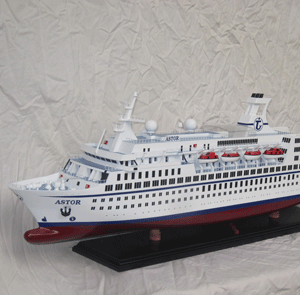
| Display cabinet, TV console, small lobby | About 70–80 cm | VICTORY (80 × 17 × 74 cm), ASTOR (80 × 12 × 38 cm), ANTEO (80 × 15 × 30 cm) |
| Large lobby, spacious living room, company office | 100 cm and up | HA LONG Sailing Boat (150 × 30 × 120 cm) |
A simple rule of thumb: leave at least 10–15 cm of free space around the model so that it has room to breathe visually, and so that you can dust it or move it without knocking the masts.
6. Understand pricing and set a budget
The price of a wooden ship model depends on its size, the complexity of its rigging, the amount of decorative detail and the time it takes to build. A multi-masted sailing ship with several tiers of sails always takes considerably more work than a solid-hulled ship with few details. To give you a sense of scale, here are some of the prices currently listed by Vietnam Wooden Ships:
- LA JACINTHE model (55 cm): 3,000,000 VND.
- THORSEN axel 1810 model (60 cm): 6,000,000 VND.
- HA LONG Sailing Boat model (150 cm): 15,000,000 VND.
The other models are listed as "contact us for a quote", because the price can change with the size and your specific requirements. It is always better to request an exact quote than to guess. When you compare prices between sellers, do not look at the number alone: compare models of the same size and the same level of detail, and ask exactly what the price includes.
7. Buying a wooden model ship as a gift
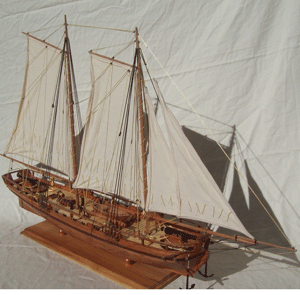
A model ship is a popular gift for business openings, housewarmings, promotions, retirements and farewells, or for foreign partners, thanks to its "fair winds and smooth sailing" symbolism and its obvious handcrafted value. To make the gift a complete success:
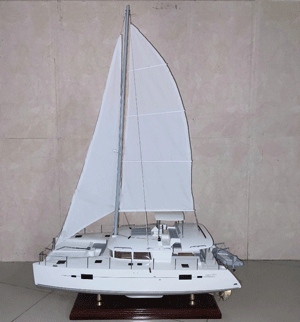
- Match the model to the recipient: business leaders often appreciate a large sailing ship that speaks of ambition and long voyages; travel lovers may prefer a cruise ship or a modern yacht such as the LAGOON 450 model; and visitors from abroad often treasure designs with a Vietnamese character, such as the Ha Long sailing boat.
- Think about transport: if the recipient lives far away or will have to take the model on a plane, choose a compact design and ask in detail how it will be packed.
- Ask about personalization: some buyers want to add a name plate, a dedication or a company logo. Ask the workshop in advance whether this is possible and how much extra time it needs.
- Order early: handmade products take time, especially for larger quantities or custom requests. Do not leave it until the last few days.
8. Should you add a display case or a stand?
A display case (acrylic or glass) keeps dust off the model, protects it from bumps and limits the effect of humidity. It is well worth considering if the model will stand in a busy area, near a window, or in a home with small children or pets. The downsides are the extra cost, the extra space it takes up, and the reflections it can create when you take photos.
If you decide against a case, the model should at least sit on a sturdy stand on a stable, level surface. You can read more about keeping your model in top condition in our article on how to care for wooden model ships and on the product care guide page.
9. Custom orders and the questions to ask the seller
Many customers want a specific ship that is not in the catalog – a vessel linked to a family memory, a ship belonging to a shipping company, or an existing model in a different size or color scheme. In that case, gather as much reference material as you can: photos of the real ship from several angles, plans or drawings if they exist, the size you have in mind, and the date by which you need the model.
Whether you are buying a model from the catalog or commissioning one, here are the questions worth asking before you confirm:
- Is this model in stock, or will it be built to order? If it has to be built, roughly how long will that take?
- Does the price include the stand, a display case, packing and shipping?
- How will the model be packed to protect the masts and the rigging during transport?
- What happens if the model is damaged in transit?
- Can I see additional photos or a video of the exact piece that will be shipped?
- If a line needs re-tensioning or a small part needs fixing after delivery, can the workshop help?
Clear, specific answers are a good sign that you are dealing with a trustworthy seller. For merchant and cargo vessels, our article on cargo ship models explains what sets each type apart before you order.
10. How to order from Vietnam Wooden Ships
Once you have found the model you want, getting in touch with the workshop is straightforward. The general steps are described on our buying guide page; for international buyers, the process usually looks like this:
- Choose your model: browse by category, such as sailing boats, cruise ships and yachts or cargo ships, or search by name or item number. Open the product page to see the photos, the item number and the dimensions.
- Build your list: add the models you are interested in to your cart to keep track of quantities. Models marked "contact us" are not included in the total – the workshop will quote them for you.
- Request a quote: send your list from the checkout page or contact the workshop directly with the item numbers, quantities and your delivery country. Ask for a written quote that states clearly what is included.
- Confirm the details: agree on the final price, the size and finish, the production time if the model has to be built, and how payment will be handled.
- Agree on packing and shipping: discuss with the workshop how the model will be packed and which shipping arrangement suits your location, and confirm who is responsible for transport, insurance and any import duties.
Summary: a checklist before you buy a wooden model ship
Before you send your order, run through this quick checklist:
- You know what the model is for: display, collecting or a gift.
- You have measured the spot where it will stand, especially the height if you are buying a sailing ship.
- You have looked carefully at close-up photos of the hull, the rigging, the sails and the paintwork.
- You know exactly what the price includes, how long production will take, and how the model will be packed and shipped.
- You know how to look after the model once it arrives.
If you are still choosing between cruise ship designs, read our guide on how to choose cruise ship and yacht models; and if maritime history is what draws you in, our article on legendary sailing ships tells the stories behind each of the models.
Frequently asked questions
What size wooden model ship should I buy the first time?
If you are new to model ships and do not yet have a fixed spot for one, a length of about 55–80 cm is the easiest to place: large enough to show off the detail, yet small enough for a shelf, a cabinet or a desk. Measure the available height first, because sailing ships are often almost as tall as they are long.
How can I tell whether a wooden ship model is well made?
Check the symmetry of the hull when viewed from the bow, how tightly the planks fit together, how neat and evenly tensioned the rigging is, the stitching of the sails and the paint in the less visible corners. Asking for close-up photos of the bow, the stern and the knots in the rigging is a quick and effective test.
How do I order a model that is priced "contact us"?
Add it to your cart and send your request as usual – it simply will not be counted in the total. The workshop will reply with a quote. You can also call +84 908 062 685 or use the contact page to get a price before you order.
Which payment and shipping options are available for international orders?
Payment and shipping for orders outside Vietnam are agreed directly with the workshop when you confirm your order. Contact us with the items and your delivery country and we will discuss the available options with you.
Can you build a model of my own ship?
Contact the workshop with photos of the real ship from several angles, the size you would like and the date you need it by. The workshop will review your material and discuss feasibility, production time and cost with you.
Need help choosing a wooden model ship?
If you are still unsure which model or size to choose, or you would like a model built to your own specifications, the Vietnam Wooden Ships team is happy to help. Call +84 908 062 685, send a request through our contact page, or visit the workshop at 199 Hamlet 1B, Phuoc Thai, Long Thanh, Dong Nai, Vietnam to see the ships in person before you decide.